
Key takeaways:
- The Fed is expected to raise rates by 0.25 percentage points this Wednesday, pushing the range to 3.75%–4%.
- U.S. inflation remains stuck at 3.4% year-over-year in August, far from the 2% target.
- A rate hike would put Kevin Warsh at odds with Donald Trump, just seven weeks before the midterm elections.
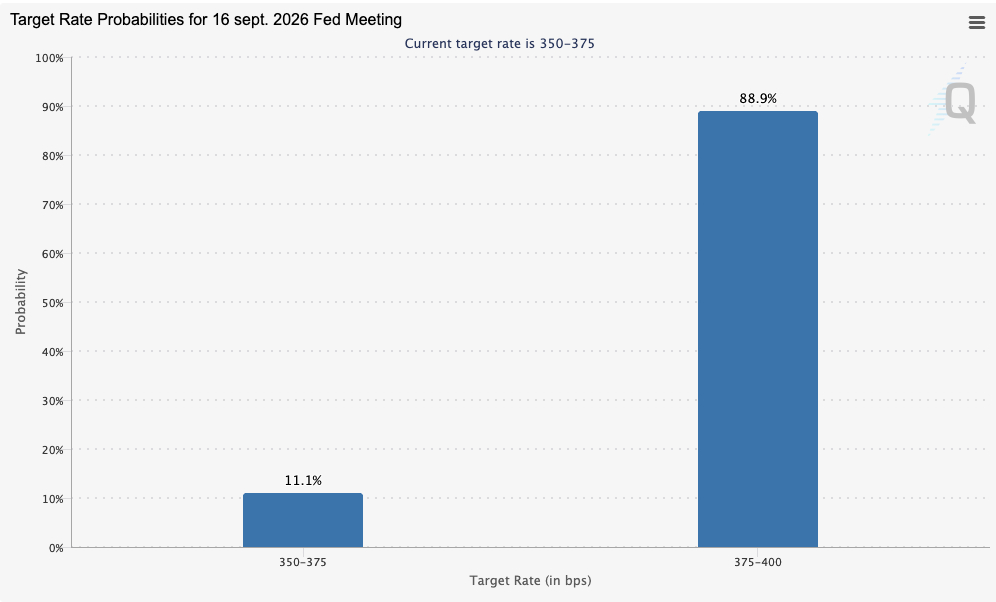
The U.S. Federal Reserve is preparing to tighten credit conditions. The Fed is expected to announce a 0.25 percentage point hike to its benchmark interest rates this Wednesday, September 16, which would bring the federal funds rate into a range between 3.75% and 4%. This would mark the Fed's first rate increase since July 2023 and the first under the leadership of Kevin Warsh.
The markets have already made up their minds. According to the CME FedWatch tool, futures contracts are pricing in a nearly 90% probability of this move, up from about 70% before the latest inflation data was released. A Reuters survey shows that 86 out of 101 economists anticipate the same outcome. Goldman Sachs and Piper Sandler, which previously expected a pause, shifted their forecasts last week.
Why is the Fed going to raise rates?
The answer boils down to one figure. The U.S. Consumer Price Index (CPI) rose by 3.4% year-over-year in August, exactly the same as in July. Inflation is no longer declining and remains far from the 2% target the central bank has been chasing for nearly five years.
Two factors are fueling this pressure. First, the tariffs imposed by the Trump administration. Second, the war with Iran: the price of a barrel of oil climbed back above 100 dollars last week, having a direct impact on energy costs.
The labor market still gives the Fed some breathing room. The U.S. economy added 162,000 jobs in August, well above Wall Street's estimates, and the unemployment rate stands at 4.1%. Most economists believe the economy can withstand a rate hike without causing damage to the labor front.
The benchmark rate has remained frozen between 3.5% and 3.75% since the cut in December 2025. In July, three members of the FOMC (Federal Open Market Committee, which sets monetary policy) had already voted against the status quo, pushing for a tightening.
Kevin Warsh puts his credibility on the line against Donald Trump
Donald Trump appointed Kevin Warsh to lower interest rates. A few months into his tenure, the new Fed Chair is preparing to do the opposite.
Warsh laid the groundwork at the Jackson Hole symposium in late August, organized by the Kansas City Fed. There, he deemed inflation more concerning and warned that the central bank would have “work to do” if prices did not slow down quickly. Trading floors interpreted this as a signal for a hike starting in September.
The Fed Chair also needs to move past his July press conference, which the Financial Times described as chaotic. Raising rates would allow him to demonstrate his independence from the White House.
Then there is the political calendar. The midterm elections are in November, and the Republican Party is counting on voters forgetting the rising cost of living. More expensive credit for households and businesses comes at the worst possible time for the administration.
U.S. rates: 10-year yield at its highest since 2007
Pressure is also coming from the bond market. The yield on the 10-year U.S. Treasury note crossed 5% on Monday, a level not seen since 2007. This rate serves as a benchmark for borrowing costs worldwide. The 2-year note, which is more sensitive to monetary policy expectations, reached its highest level since July 2024 on Tuesday.
Investors are also worried about federal debt, which is nearing 40 trillion dollars. In a survey by the Financial Times and the University of Chicago’s Booth School of Business, two-thirds of the 51 economists polled expect the 10-year yield to be between 5% and 5.5% in a year.
Markets caught their breath on Wednesday ahead of the announcement. The 10-year yield pulled back to 4.95% and the 2-year to 4.61%, while the S&P 500 gained 0.4% and the Nasdaq 0.8%, buoyed by a dip in oil prices.
What to watch tonight
The decision is due at 2:00 PM in Washington, which is 8:00 PM in Paris. Kevin Warsh will hold a press conference thirty minutes later.
With the rate hike all but certain, the dot plot will be the center of attention. This quarterly chart compiles anonymous interest rate projections from each Fed official. If officials project another hike this year and one more in 2027, the dollar could strengthen. Citi, by contrast, believes Warsh might frame this move as a simple adjustment, not the start of a tightening cycle. Investors will gauge the tone of his press conference.
Stay updated with the latest news in our TradFi section on Coin Academy.